Digital Ecologies: Q&A with Dr. Nikoleta Zampaki


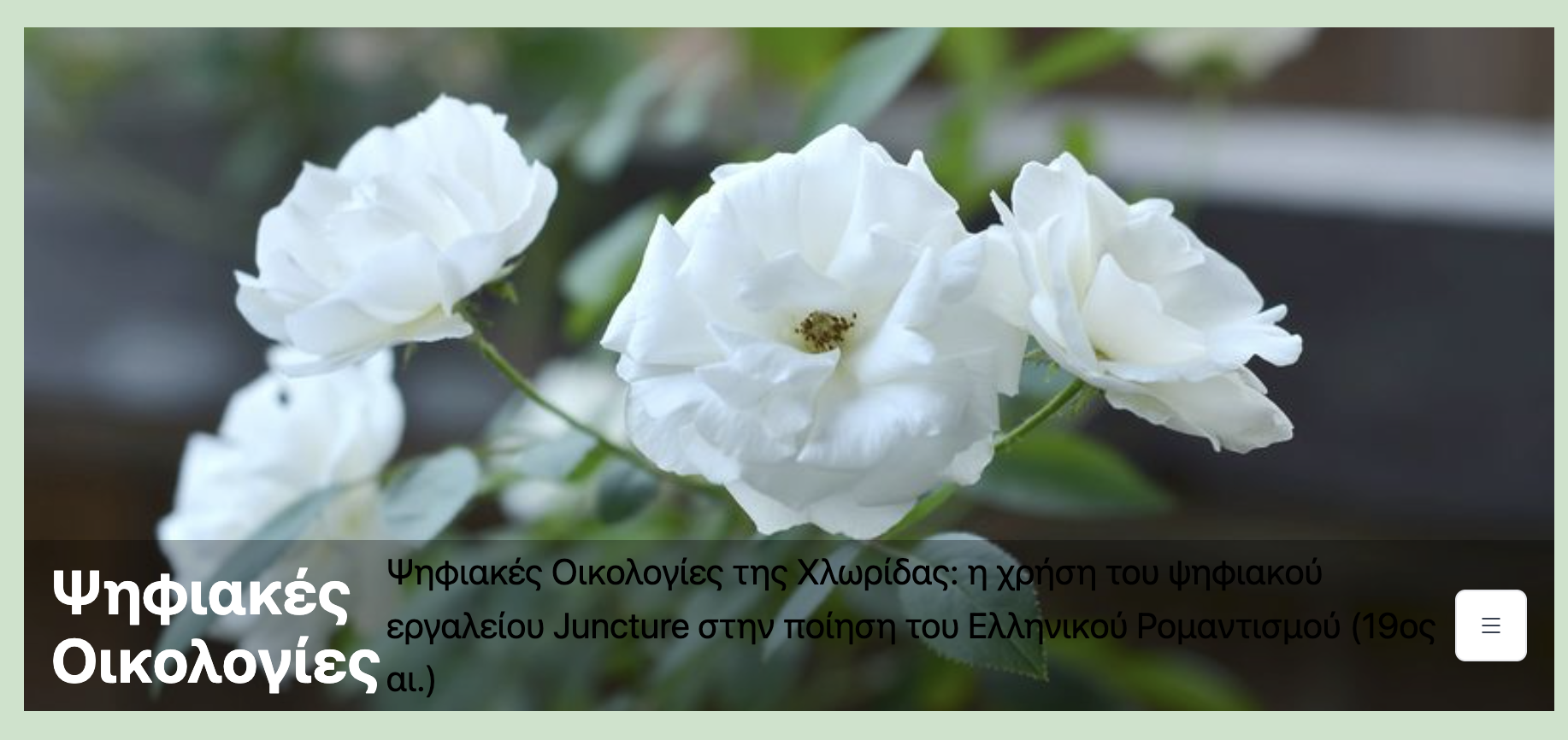
Dr. Nikoleta Zampaki first approached us about working with Juncture in 2021. Inspired in part by the release of our collaboration with Dumbarton Oaks, the Plant Humanities Lab, she reached out with interest in creating her own exploration in environmental humanities. That exploration became Digital Ecologies, which while it was still being built took second place at the 2023 DH Awards for Best DH Tool. Digital Ecologies traces mentions of plant species in Greek Romantic poetry from the 19th Century; I encourage you to check it out (especially if your Greek is better than mine is). Dr. Zampaki is an intrepid, tenacious scholar; ITHAKA Labs graciously thanks her for sharing here her experience building Digital Ecologies using Juncture.
- Alex Humphreys
I would like to give my special thanks and deep gratitude to Alex Humphreys and Ryan McCarthy at ITHAKA Labs for their warm support, quick assistance, and kindness during my research.
- In a few sentences, describe your Digital Ecologies project and what was new/unique about it.
My postdoctoral research entitled “Digital Ecologies of Flora: the use of the digital tool Juncture in the poetry of Greek Romanticism (19th century)” has been defended in the Faculty of Philology of the National and Kapodistrian University of Athens in Greece, under the supervision of Peggy Karpouzou, associate professor of theory of literature of the same faculty and university. The research has been designed with the open-access digital tool Juncture, created by JSTOR Labs (now ITHAKA Labs), a partner of this postdoctoral research. The objectives of this research were to enrich the study of flora in the environmental humanities. This postdoctoral research differs from existing digital repositories for flora, as it constitutes the first and organized digital repository for the study of flora in 19th-century Greek Romantic poetry. Furthermore, for the first time, a Greek-language code in polytonic is written using a foreign-language digital tool. The research’s website is open access and can be seen here: https://digitalpeni.org/
- Why did you select Juncture for this project? What did it offer that you didn’t see in other offerings?
- Open Access: The digital tool Juncture lays the foundation for the creation of a multimedia research project and more specifically, a digital repository of references (verses or body of verses) of 19th-century Greek Romantic poetry.
- Data Mining -> Annotation (with parameters) -> Coding (Markdown) -> Visualization: The methodology of this research combines data mining from a specific body of texts, its categorization by author and work, the recording of the texts in the digital tool Juncture using the Markdown markup language, and its multimedia visualization.
- Identification of rare flora species: Through the digital recording of flora in the poetic texts of Greek Romanticism of the 19th century, references to rare flora species are identified.
- Interdisciplinary: Literary analysis is combined with environmental knowledge (cataloging of Greek flora).
- What was your experience like using Juncture on this project?
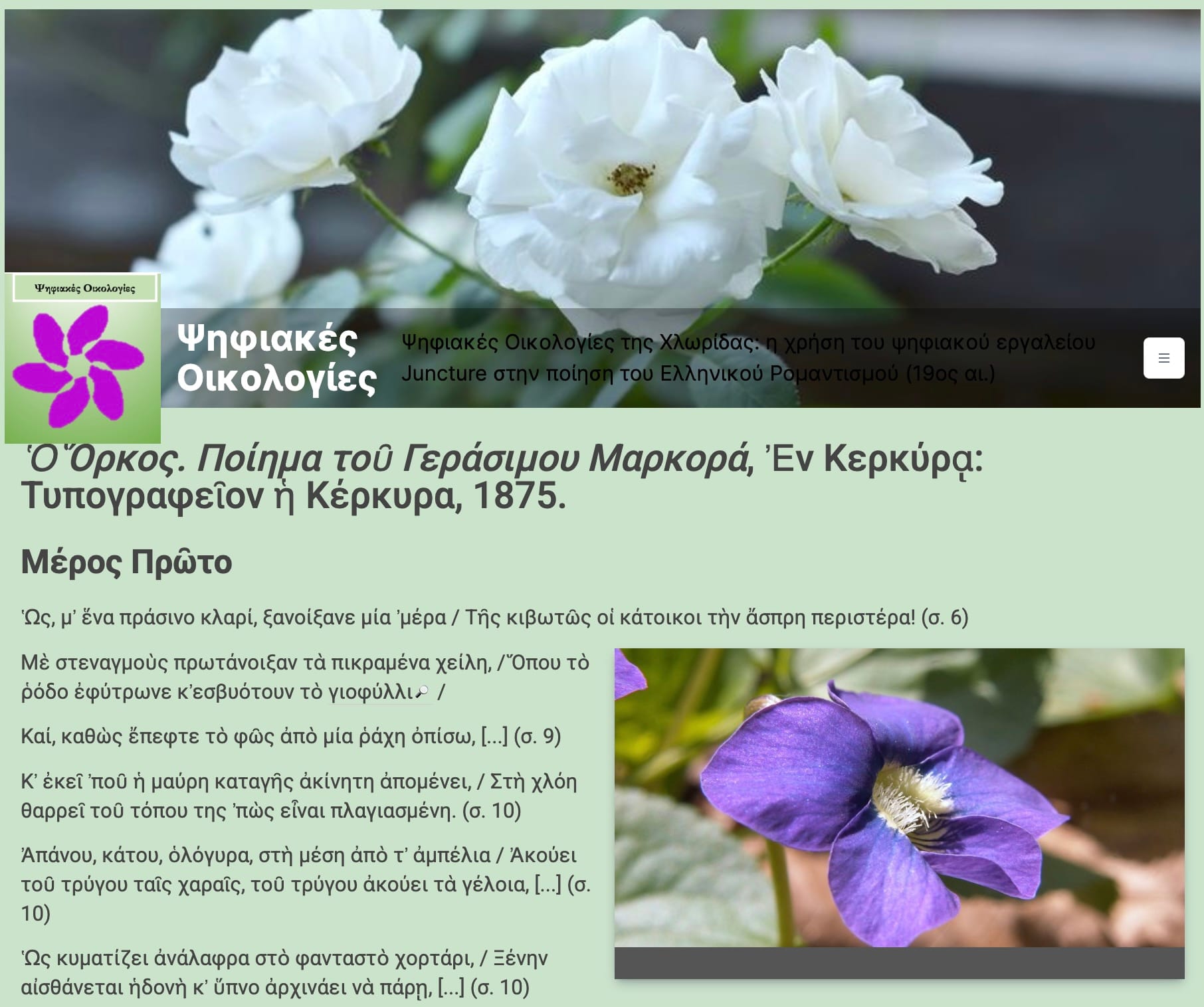
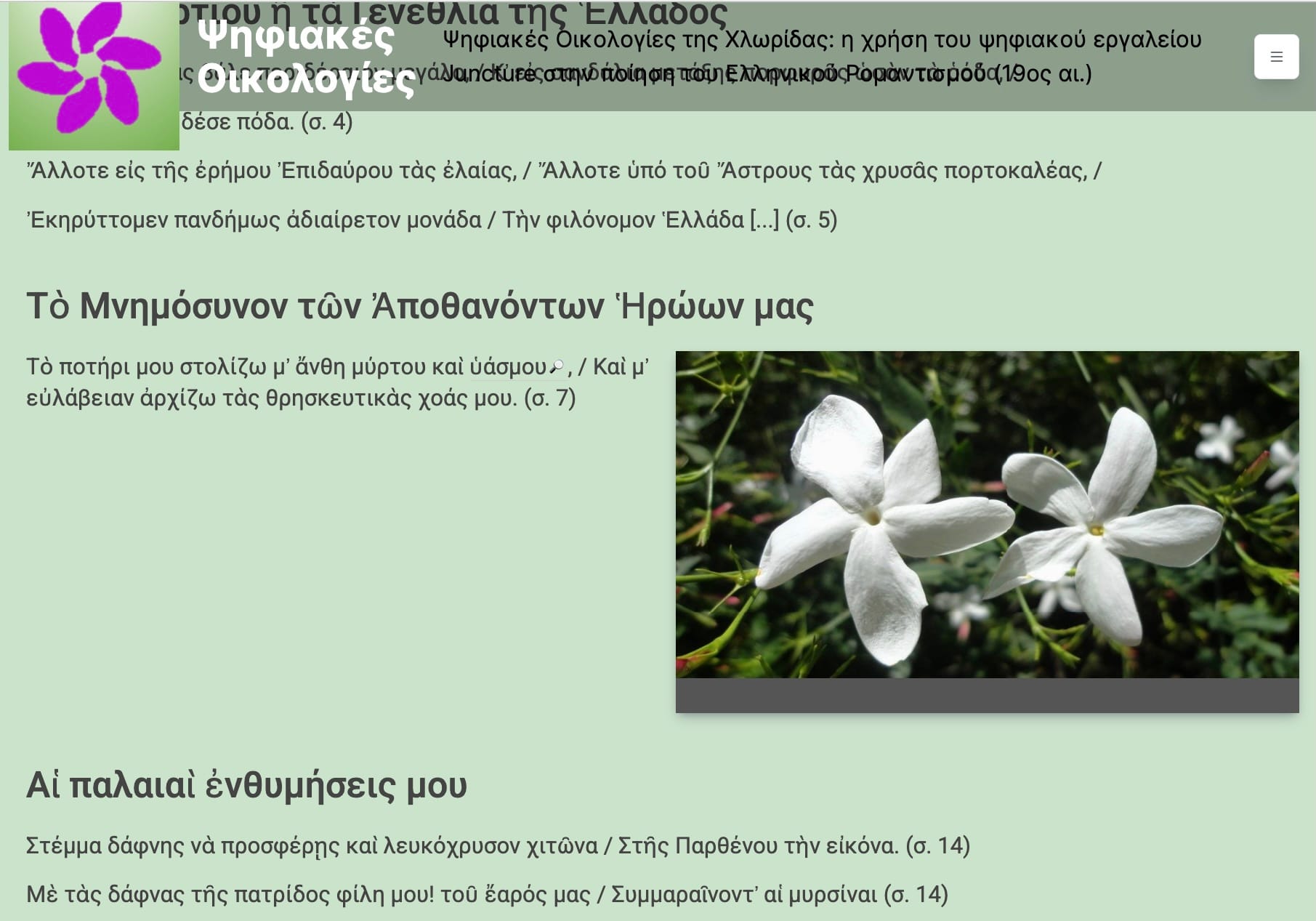
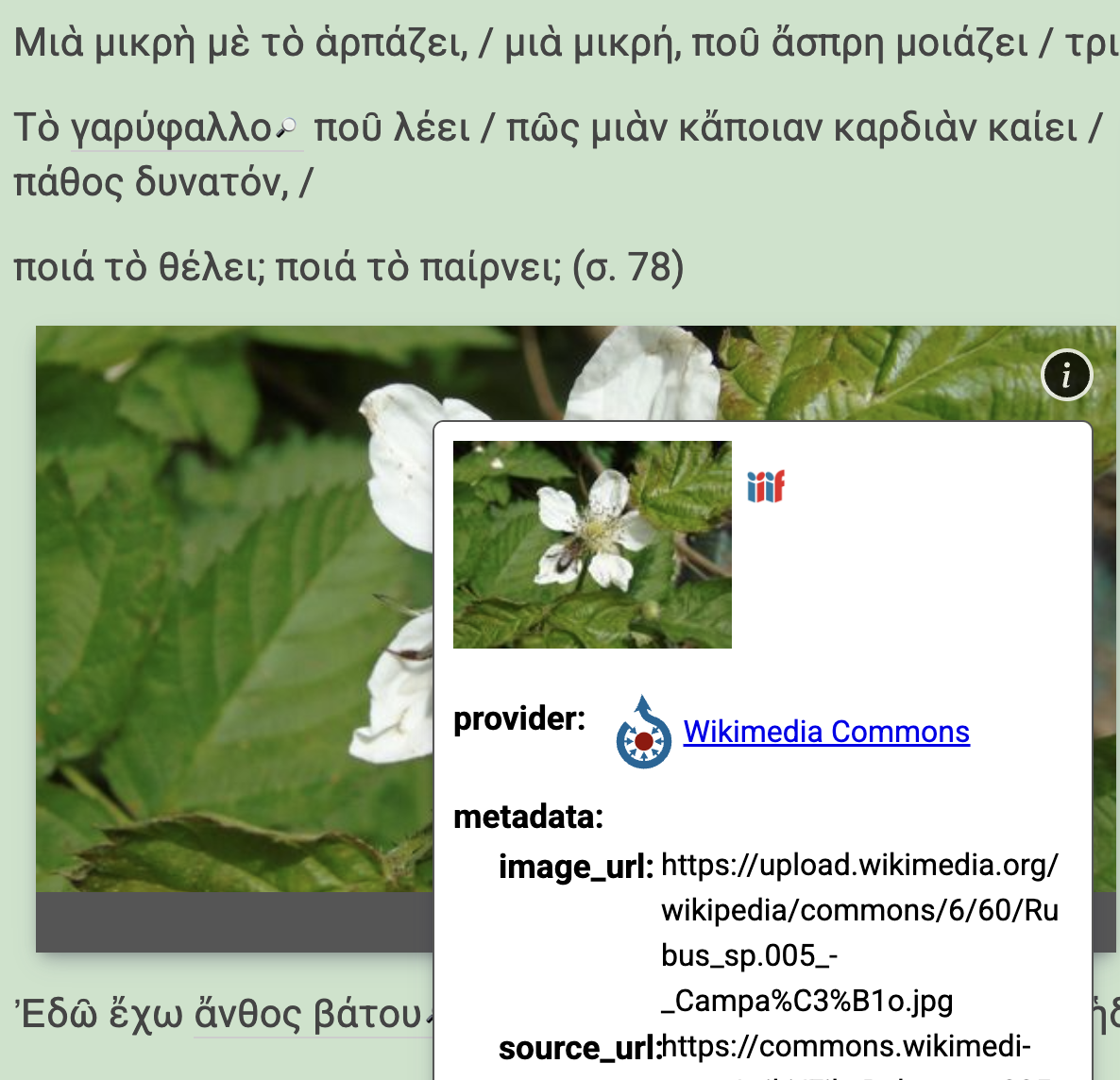
It is a great experience working on Juncture, as it is easy to use and enhances any scholar’s computer skills in writing any kind of text (e.g., literary, artistic, and so forth), using basic Markdown knowledge. The result is a multimedia website, full of hyperlinks, photos, and so forth alongside the texts, which are helpful to navigate ourselves within a project’s content.
- What advice would you give to someone else starting a project with Juncture?
Learn the basics of Markdown and then be creative. As an environmental humanities scholar, it will be great to see more projects written in digital tools like Markdown.
- How have you shared your project, and what type of response has it received?
My project is written in the Greek language, aiming to be a useful database for scholars and educators in Greece. The response of such projects is positive as applied research enhances communities’ skills on computers, shares knowledge around Digital Humanities, and their use of them in other fields of humanities, such as literature, and also lays the ground for interdisciplinary projects. I hope to see more projects in various languages in Juncture, and also see more options of the tool in the next updates of it, such as automatic translation, hyper-connections between different texts, authors, and so forth.
- Now that you have defended your postdoc research, what are your plans? How will you build on this experience?
My current and next plans are to work on interdisciplinary projects on comparative literature, environmental humanities, posthumanities, and digital humanities, working closely on the so-called “nonhuman turn” in how the digital systems are intersected with ecosystems, exploring further the field of digital environmental humanities theoretically and through examples. This interaction helps me understand better the complexities between agencies.
Dr. Nikoleta Zampaki
Adjunct Lecturer
Faculty of English Studies
University of Information Technology and Management, Poland
E-mail: nzampaki@wsiz.edu.pl